

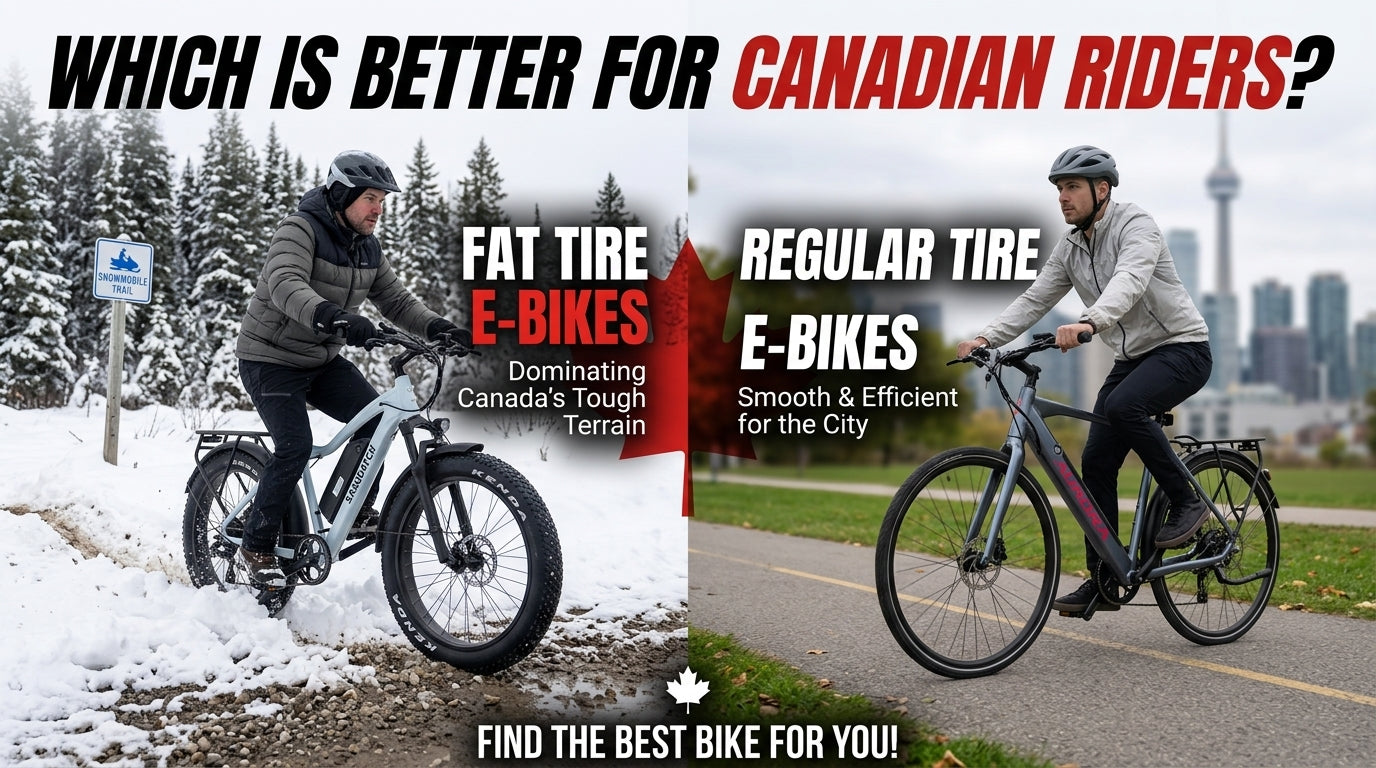
If you’ve been shopping for an e-bike, you’ve probably noticed that some models come with big, wide fat tires, while others look much more like a traditional bicycle with narrower tires.
So, what’s the difference?
And more importantly, which type of e-bike is better for riding in Canada?
The answer isn't as simple as saying one is better than the other. Both have their advantages, and the right choice depends on where you ride, how often you ride, and what kind of terrain you expect to encounter.
For Canadian riders, this is especially important. We can go from smooth pavement to gravel, potholes, wet trails and, depending on where you live, plenty of snow and ice.
Let's take a closer look at fat tires and regular tires so you can decide which makes the most sense for you.
What Is a Fat Tire E-Bike?
A fat tire e-bike uses significantly wider tires than a conventional bicycle. Most fat tires are around 4 inches wide or more, although exact sizes vary between models.
The idea behind a fat tire is simple: a wider tire provides a larger contact area with the ground and can be used at lower air pressure.
That combination gives the bike a very different feel.
Instead of feeling like you're riding over every small bump and crack in the road, the tires can absorb some of those imperfections and provide a smoother, more planted ride.
Fat tire e-bikes are particularly well suited to:
- Snow
- Gravel
- Sand
- Grass
- Dirt trails
- Mud
- Rough pavement
- Uneven surfaces
They can be a great option for riders who don't want their e-bike limited to perfectly paved roads.
What Is a Regular-Tire E-Bike?
Regular-tire e-bikes use narrower tires, generally closer to what you would find on a conventional bicycle.
They're designed primarily for paved roads, bike lanes, sidewalks where permitted, and well-maintained paths and trails.
Because the tires are narrower and generally lighter, these bikes can feel more responsive and efficient on smooth surfaces.
Regular tires are particularly well suited to:
- City commuting
- Paved roads
- Bike paths
- Smooth recreational trails
- Longer road rides
- Riders who prefer a lighter, more agile bike
If most of your riding is on pavement, you may not need the additional size and weight of a fat tire.
Fat Tire vs. Regular Tire: The Main Differences
Here's a quick way to think about it:
| Feature | Fat Tire E-Bike | Regular Tire E-Bike |
|---|---|---|
| Snow | Excellent | Limited |
| Gravel | Excellent | Good |
| Rough terrain | Excellent | Good |
| Paved roads | Good | Excellent |
| Comfort | Excellent | Good |
| Stability | Excellent | Very good |
| Maneuverability | Good | Excellent |
| Rolling efficiency | Good | Excellent |
| Weight | Usually heavier | Usually lighter |
| Versatility | Excellent | Good |
These are general comparisons. The actual performance of an e-bike depends on much more than tire width, including tire tread, tire pressure, motor, suspension, rider weight and the terrain you're riding on.
Why Fat Tires Can Be a Great Choice in Canada
Canada isn't exactly known for having year-round perfect cycling conditions.
Depending on where you live, your e-bike may encounter everything from smooth pavement and bike paths to gravel roads, potholes, wet trails and snow.
That's one reason fat tire e-bikes have become so popular among riders looking for a more versatile bike.
1. Better on Snow
This is probably the first thing that comes to mind when people hear "fat tire."
The wider tire spreads the rider's weight over a larger area. On loose snow, this can help the tire stay closer to the surface instead of sinking as deeply as a narrow tire.
If you enjoy winter riding, a fat tire e-bike can therefore be a very useful tool.
But there's an important warning:
Fat tires don't make ice safe.
Snow and ice are two very different riding conditions. Even a wide tire can lose traction on a smooth icy surface. If winter riding is part of your routine, appropriate winter tires—and, where suitable, studded tires—can be much more important than simply having a wider tire.
Always use extra caution when riding in winter conditions.
2. A More Comfortable Ride
One of the things riders notice immediately with a fat tire e-bike is the feeling of the ride.
The larger tires can be run at lower pressures, allowing them to absorb bumps and vibrations from the road or trail.
This can be especially noticeable on:
- Cracked pavement
- Gravel roads
- Potholes
- Uneven trails
- Hard-packed dirt
- Rough bike paths
If comfort is high on your priority list, fat tires are worth considering.
3. Greater Stability
Fat tires also give many riders a greater sense of stability.
The wider footprint can make the bike feel planted underneath you, particularly on loose or uneven surfaces.
This can be appealing if you're a newer e-bike rider or simply prefer a relaxed and confident riding experience rather than a lightweight, sporty feel.
4. More Freedom to Explore
Perhaps the biggest advantage of a fat tire e-bike is versatility.
You don't necessarily have to turn around when the pavement ends.
A gravel path, dirt trail or grassy area can become part of your ride.
For riders who use their e-bike for recreation rather than simply commuting from A to B, that extra versatility can make a big difference.
Why a Regular Tire Might Be Better for You
Fat tires sound great—and they are—but bigger isn't always better.
If you spend most of your time riding on smooth pavement, a regular-tire e-bike may actually be the better fit.
1. Efficient on Pavement
Narrower tires generally roll more efficiently on smooth, hard surfaces.
For someone commuting through the city or riding primarily on paved paths, this can make the bike feel quicker and more effortless.
If your typical ride looks like:
Home → paved bike path → road → coffee shop → home
you may not need a full fat tire.
2. Usually Lighter
Fat tires are bigger, and so are the wheels and other components designed around them.
As a result, fat tire e-bikes are generally heavier than comparable bikes with narrower tires.
This matters if you frequently need to:
- Lift your bike
- Carry it up stairs
- Put it in a vehicle
- Store it inside a small space
- Load it onto a bike rack
For some riders, reducing weight is more important than having maximum off-road capability.
3. More Agile Handling
Regular tires can give an e-bike a lighter and more nimble feel.
If you're navigating busy streets, bike lanes or tight paths, you may prefer the quicker steering response of a narrower tire.
For urban riders, this can be a real advantage.
What About Riding an E-Bike in a Canadian Winter?
This is where things get a little more complicated.
It's easy to assume:
"I live in Canada, so I need a fat tire e-bike."
Not necessarily.
Canadian winters are very different from one region to another—and even within the same city, your riding conditions can vary from day to day.
For example, one rider might spend the winter riding on roads and bike paths that are regularly cleared.
Another rider might live outside the city and regularly travel through fresh snow, gravel and unplowed trails.
Those riders have very different needs.
A fat tire is worth considering if you:
- Ride regularly in snow
- Use trails that aren't always cleared
- Ride on gravel or dirt
- Want a very comfortable ride
- Frequently encounter rough or uneven surfaces
- Want an e-bike that can handle a variety of terrain
A regular tire may be the better choice if you:
- Mostly ride on pavement
- Primarily commute around the city
- Ride mainly from spring through fall
- Prefer a lighter bike
- Prioritize efficiency
- Need to transport or store your e-bike frequently
And regardless of tire type, be extremely careful around ice.
Does Tire Size Affect E-Bike Range?
It can.
Wider, heavier tires generally create more rolling resistance than narrower tires, particularly on smooth pavement. This can affect how much energy your e-bike uses.
However, don't assume that tire width alone determines your range.
Battery size, motor power, rider weight, riding speed, terrain, tire pressure, wind and temperature can all have a significant impact.
Cold weather is also something Canadian riders should consider. Battery performance can be affected by low temperatures, so winter range may not be the same as summer range.
If you plan to ride throughout the winter, think about the whole e-bike, not just the tires.
Is There Something Between Fat Tires and Skinny Tires?
Absolutely.
You don't necessarily have to choose between a huge 4-inch fat tire and a narrow road-style tire.
Many e-bikes use mid-width tires, often around 2.2 to 2.5 inches wide.
These can provide a nice balance between the two.
You get some of the additional comfort, traction and stability of a wider tire without all the extra size and weight of a full fat tire.
For Canadian riders who spend most of their time on pavement but occasionally venture onto gravel trails or encounter rougher conditions, this can be an excellent compromise.
So, Which E-Bike Tire Is Right for You?
Instead of asking "Which tire is better?", ask yourself:
"Where am I actually going to ride?"
Fat tires may be right for you if:
✔ You want to ride in snow
✔ You enjoy gravel and off-road trails
✔ You frequently ride on rough surfaces
✔ Comfort and stability are important to you
✔ You want maximum versatility
✔ You want to explore beyond paved roads
Regular tires may be right for you if:
✔ You primarily ride on pavement
✔ You use your e-bike mainly for commuting
✔ You want a lighter bike
✔ Efficiency is a priority
✔ You frequently transport your e-bike
✔ You prefer a more agile riding experience
The Bottom Line
There isn't a universal "best" e-bike tire.
A fat tire e-bike isn't automatically better than a regular-tire e-bike, and a regular tire isn't automatically better just because it's lighter or more efficient.
The right tire is the one that matches the way you ride.
For Canadian riders who deal with snow, gravel, rough roads and changing conditions, fat tires can provide excellent comfort, stability and versatility.
For riders who spend most of their time commuting on pavement and well-maintained paths, regular tires can provide an efficient, lightweight and responsive riding experience.
And if you're somewhere in between, a mid-width tire may give you the best of both worlds.
Before choosing an e-bike, think about your typical route—not just the conditions you might encounter.
After all, the best e-bike isn't necessarily the one with the biggest tires.
It's the one that makes you want to ride.
EBIKECAN TEAM.
![[REVIEW] Lancet 2.0 Core by Ebike Escape](http://www.ebikecan.ca/cdn/shop/articles/81dc52ab-798f-42b7-b185-0e087564f264_82e14859-71bd-4774-9555-8840f9cbc04b.jpg?v=1769289767&width=800)
Partager:
Ontario E-Bike Laws; Everything You Need to Know Before You Ride!